
Understanding AI —
a plain-language guide
No jargon, no hype. This guide breaks down how artificial intelligence actually works, so you can use Worx-AI with confidence and make sense of what's happening behind the scenes.
In This Article you will find:
What is AI? | How AI Learns | Key Concepts | Prompts | Tokens | What AI can do and can't do
What is artificial intelligence?
Artificial intelligence refers to computer systems that perform tasks that typically require human reasoning — things like understanding language, recognizing patterns, making predictions, or generating text and images.
Unlike traditional software, which follows a fixed set of rules written by developers, AI systems learn from examples. Instead of being told exactly what to do in every situation, they are exposed to large amounts of data and adjust their internal logic until they get good at a task.
How It Works?
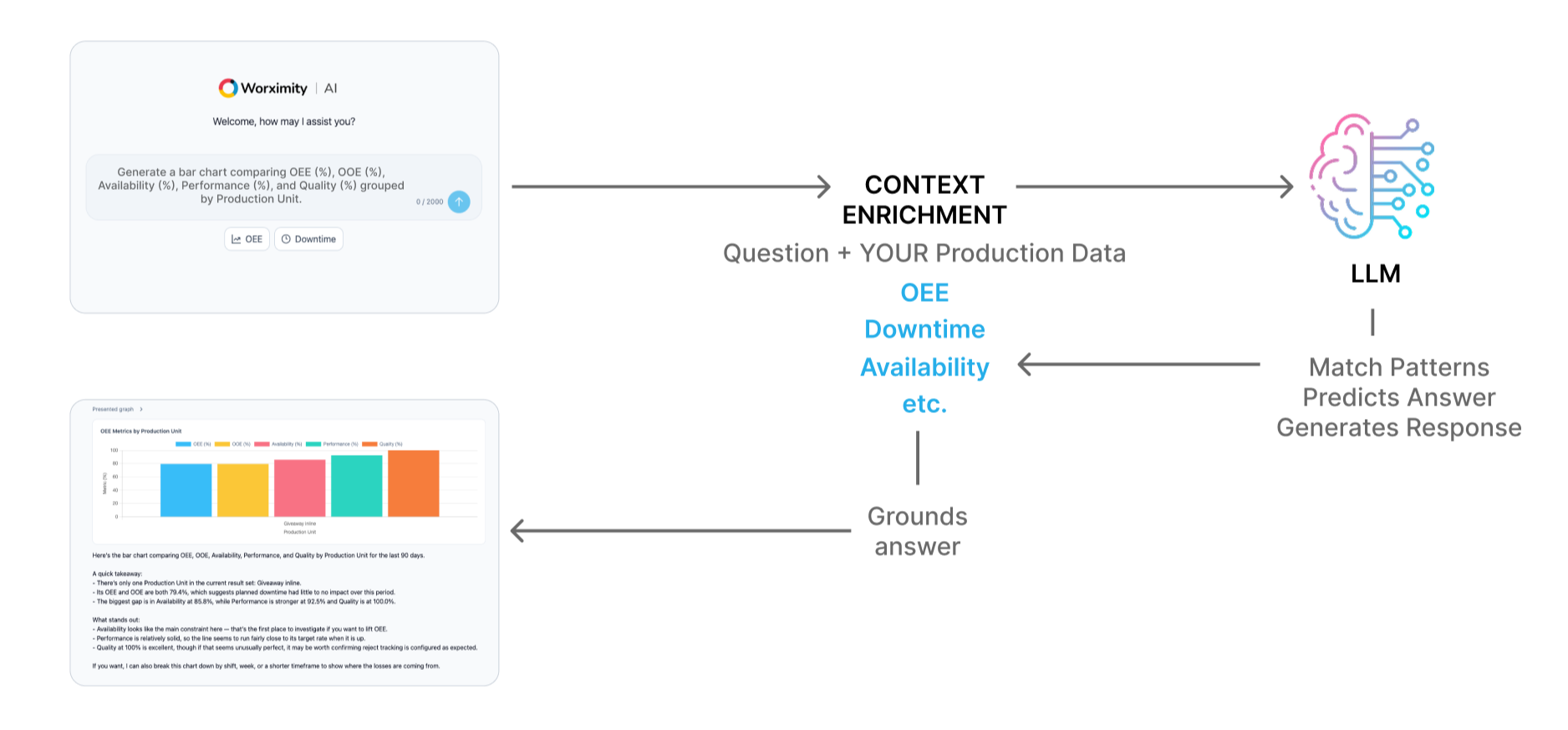
Key Concepts

LLM (Large Language Model)
is a type of AI trained on vast amounts of text. It learns the statistical patterns of language — which words tend to follow which — and uses this to generate coherent, contextually relevant text. GPT-4, Claude, and Gemini are all LLMs. The "large" refers to the enormous number of parameters (sometimes hundreds of billions) inside the model, which is what gives it its broad capabilities.

AI model
is the finished result of the training process — a mathematical structure (technically a neural network) that takes an input and produces an output. Think of it like a very sophisticated function: you give it a question, it gives you an answer. The model doesn't "know" anything in the human sense; it calculates the most probable response based on patterns learned during training.

Context Window
is how much text the AI can "see" at one time — it's like short-term memory. If a conversation is too long, the AI may lose access to things said at the beginning. For Worx-AI, the context includes your question, any data passed in, and the conversation history. Context windows are measured in tokens and vary by model.

Inference
is what happens when the trained model is actually used — when it reads your question and generates a response. During inference, the model's weights are fixed (it's not learning or updating). It simply processes the input token by token and predicts what should come next, very quickly. Every time Worx-AI answers your question, that's inference happening.

Temperature
is a setting that controls how deterministic or creative the AI's responses are. A low temperature (close to 0) makes the AI stick to its most probable answer — useful for factual, analytical tasks like reading your OEE data. A high temperature makes it more varied and creative, useful for brainstorming. Worx-AI is configured with a low temperature to ensure its analysis is grounded and consistent.

Embeddings
are how AI converts words and phrases into numbers (vectors) so it can understand relationships between concepts. Words that are semantically similar end up with similar numerical values. This is why the AI understands that "downtime" and "unplanned stop" refer to similar things, even if the exact words are different. Embeddings are the foundation of how AI searches for meaning, not just keywords.

Retrieval-augmented generation (RAG)
Retrieval-augmented generation (RAG) is a technique where an AI system first retrieves relevant information
from a database or set of documents, then uses that information to generate a response.

Hallucinations
Hallucinations happen when AI generates content that sounds confident and plausible, but is factually wrong or completely made up.
Prompts — how you talk to AI
A prompt is any instruction or question you give to an AI model. It's the input that triggers a response. But not all prompts are equal — the way you phrase your request has a large impact on the quality of the answer you get.
A well-structured prompt typically includes four elements: Context, Role, Task, Format.
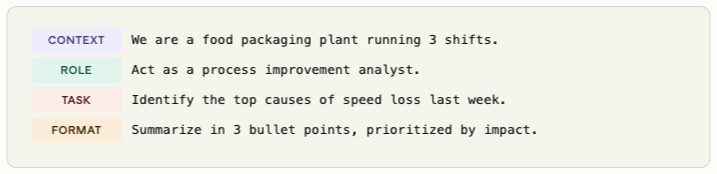
The more relevant context you provide, the more targeted and useful the AI's response will be. Vague prompts produce generic answers. Specific prompts produce specific, actionable insights.
